Pauca Verba is Latin for A Few Words.
Showing posts with label St. Stephen. Show all posts

Saturday, December 26, 2020

"On the Feast of Stephen"


"Good King Wenceslas looked out on the Feast of Stephen." In other words, the good king looked out of his castle window today, the day after Christmas. Strange, yesterday celebrated a birth; today remembers the awful death of a young man. Stephen, whose feast is older than Christmas, is called the Protomartyr — the first. To love and learn from Christ is going to cost me something. 

This painting by the 17th century artist, Bernardo Cavallino is filled with emotional energy. Stephen wears a deacon's dalmatic. Red is the liturgical color of a martyr. In front and behind there's an agitated, angry mob. No women. In the upper right corner notice even the sky is troubled. We see the city wall. Like Jesus, Stephen was taken outside the city to die. The biblical account of the saint's work and death is found in Acts of the Apostles 6,7.

But one verse gets my attention, "he looked up."  Very busy, preoccupied people never look up. They only look straight ahead to where they're hurrying or they look down determinably, making no eye contact. But "look up" can also have symbolic meaning. "Look up" as if out of the bubble world we can find ourselves in — encased in the world of someone else's ideas we've picked up along the way without thinking. This is played out dramatically these days in our post election world of denial — I believe it because someone said it — especially someone I've invested with authority. Some people never look up  in this sense.

And what did the deacon-martyr see when he looked up? Bernardo Cavallino understands. Stephen didn't see Jerusalem's glorious temple; that's behind him. Rather this:

But he, (Stephen), full of the Holy Spirit, looked up into heaven and saw the glory of God, and Jesus standing at the right hand of  God; and he said, "Behold, I see the heavens opened, and the Son of man standing at the right hand of God."

It's at that point that the listeners can't stand it anymore and they "cried out with a loud voice and stopped their ears and rushed together upon him." And they stoned him to death.

Stephen saw "the heavens opened and Jesus standing with God." Standing is the posture of readiness and action. What does it mean? The point of contact with God is no longer a splendid building, but the person of Jesus Christ. The heavens are opened over all of us — not a prefered or exclusive some of us. That line has tremendous personal implications — political implications, religious implications, racial implications. 

But when we delve deeply into those implications/possibilities, that's when people still cover their ears and rush about screaming (if even inwardly) to put someone or something (maybe the ideas themselves) to death. 

This first martyr's feast day, in the Christmas Octave, might be an invitation for me to look up and out of the little sphere of my world in some new way, to allow for the new vision, the new universal vision of the one who lived his life most authentically. It's a life changer.


Wednesday, December 26, 2018

Psalm 30 ~ Trusting God in Times of Distress ~ "On the feast of Stephen..."


Talk about stress and distress, read the account of Saint Stephen's trial and martyrdom in Acts 6-7. Stephen's feast day is today, December 26. Strange, but not really, as his liturgical feast day is actually older than Christmas. 

The Responsorial Psalm at Mass is Psalm 30, a long psalm, which the Latin Rite Mass truncates to about six verses. The Anglican liturgy keeps the psalm intact - all 25 verses. I wonder if we do that because we don't like struggling spiritually with the difficult bits. 

Anyway, click on the late 15th century, painted wood statue of Stephen above (he holds a Gospel Book and stones) to hear the psalm read. Below are some thoughts about the verses - all of them.

Verse 1-3: Right out of the gate, the worn down psalmist is declaring he's all wrapped up in troubles and shame. He asks God to rescue him, speedily.

Verse 4: The psalmist uses vivid language reflecting the depth of his plea: "Be a refuge, stronghold and rock; lead me; guide me." 

Verses 5-6: This fellow is in some kind of trouble unknown to us. It doesn't really matter; we know life is hard, dangerous and sometimes menacing. We can each identify this personally. We hear the words of Jesus on the cross, "Into your hands I commend my spirit." They are not quite the same as "Thy will be done," but they are God-pleasing.

Verses 7-8: God detests the empty gods we create: money, pride, militarism, power-lust...you name it. The psalmist disowns these false deities and declares his happiness is found in God's love.

Verse 9: His trouble is deep indeed - he says he's soul-sick. Who is the enemy he's troubled by? We don't need to know. Rather, to live on this planet is to experience at some time or other, a personal problem that is niggling and enervating - something that could take me off my feet.

Verse 10: Is the psalmist exaggerating the depth of his problem? He's crying over it. This is poetic language to describe a person who is broken-hearted or heart-sick.

Verse 11: This trouble has afflicted him for years, leaving him worn out and wasted. Could anything really be so bad? Ask a depressed person, or a parent who has lost a child, or a war-damaged soldier, or someone who can't get out of poverty, or has an addicted spouse or child...

Verse 12: What an awful condition this fellow is living in! His life-picture is one of lonely alienation. I think he is setting us up for some spiritual surprise.

Verse 13: The psalmist feels "Like a thing thrown away."  And I am thinking of how the world throws God away, like a worn out or broken thing we consider garbage. Throwing God away in our cultural thinking, in our politics, in our hatreds. It's increasingly hard to find a Christmas card with a nativity scene on it. 

Verse 14: The poor fellow is riddled with fears. He feels there's even a plot to take his life. Have I ever felt overwhelmed with fear? He hears he's being slandered. "Every priest has his detractors" a pastor told me when I was a young priest.

Verses 15-16: Ah, there it is, the spell has been broken! Despite all his sorrow, "You are my God, my life is in your hands..."

Verse 17: The psalmist loves the idea of seeing God's face, which he likens to light. He is pleased that God has love in store for him, but he can't imagine yet that God loves his enemies as well.

Verse 18-19: He still wants God to do his bidding and to take out his revenge on these enemies. Oh my! "Let them be silenced in their graves, strike them dumb." It's not the Christian way, though there are many spiritually immature Christians who think like this. 

Verse 20: The psalmist declares God's goodness. Fearing God, doesn't mean shaking in your boots, but fearing the loss of God. After the words "fear you" the next line echoes with "trust you." 

Verse 21: Life can un-ravel, leaving us fragmented and in a heap, can't it? But God's sheltering is sure. God has us in his tent.

Verse 22: The wonders of his love. Not miracles, but wonders! Miracles are rare, but wonders are all around and every day. Can I name this for myself?

Verse 23: Poor thing; he can't help himself. He falls back into his dejection for a moment. Don't we do that - ruminating on what's wrong, spinning round and round in the troubles? How do we get far removed from God's sight? Maybe our illusions and anxieties do that.

Verse 24: Love the Lord, the psalm invites; the God who guards us. And don't be prideful - let God be God.

Verse 25: And his final thought: through all the troubles, disappointments, set backs, distractions and weariness - Let your heart take courage. It never fails - no matter how the psalmist goes down the road of woe and complaint, he always ends on a note of confidence and strength renewed. 


Tuesday, December 26, 2017

"On the Feast of Stephen...."


The day after Christmas is the Feast of St. Stephen, the Proto-Martyr and Archdeacon. The liturgical color for the Mass this day is red, not because it's a Christmas color but to remember the saint's shed blood. 

Here the young Stephen wears a gold dalmatic, the vestment of his office. He holds the Divine Word in his right hand and the stones of his martyrdom in the left. Gathered around his neck and shoulders he wears an amice, the deacon or priest's linen vestment touched to the back of the head while praying for the expulsion of dark-cornered thoughts. "Everyone should wear an amice" a teenaged altar server said after hearing my explanation of the amice I'd just put on.

We read the account of Stephen's martyrdom in Acts of the Apostles 6-7, being told that while Stephen was being crushed  under a hail of rocks, the righteous, religious zealot Saul (later Paul) stood holding coats and approving of the saint's death. This is perhaps the other side of the Stephen account: religion can kill.

Some of us have been listening lately to proud Evangelical Christians interviewed in Alabama. A parishioner-friend said, "These people use religion to condemn anyone who isn't like them. Their religion is killing them, and they don't even know it."

I'm thinking of religion-referenced Dr. Laura some years ago on the radio. A religious woman phoned in with the dilemma of her grown daughter turning up pregnant and unmarried. She told Laura that she had an attic full of the clothes her own newborns wore when she was a young mother and, "Should I give all of this clothing to my now pregnant daughter?" In a heartbeat Dr. Laura answered, "No, pack up the clothes and give them to Good Will."  Religion can kill, snuffing out compassion and love. How can we get it so wrong some times?

Not a few people have made of their Christianity an ethic, proposing to assess and judge everyone they consider "different," "other,"  "illicit," "illegal," "unwelcome," "uninvited." Saul, whose soul was blinded by his own pious observances, had to be knocked down on the Damascus Road and then enlightened by the voice of Jesus. The soon ending year of 2017, a year of sad bitterness often spawned by wrong-turned religion, needs a prayer.


Oh newborn Christ,
loosen up these knotted hearts of ours,
warm our winter-chilled assessing,
the icy condemnations,
the cold condescensions and
threatening exclusions.
Heal our hearts, clogged with dissatisfaction -
all the tysking,
having so much to say about everyone else,
the stinking other-ism that
vilifies, shames and kills.

Oh, new-born Child of Bethlehem,
give us new hearts,
but smiles too,
like your Mother's,
who called, "Come on in" to shepherds,
on no one's Christmas card list,
standing all breathless,
nerved out and shy.
shivering at the door of the cave.

Father Stephen P. Morris

Saturday, December 26, 2015

December 26 ~ Feast of Stephen ~ Proto-martyr, Archdeacon, Reconciler and Waiter


"Good King Wenseslaus looked out on the Feast of Stephen." That's today! The Feast of St. Stephen the First Martyr is the day after Christmas. The first feast celebrated by the early Christians was Easter of course, and then every Sunday celebrated as a little Easter, and then the days martyr's went home to heaven. Christmas wasn't put on the Christian calendar for a few centuries. So today the priest wears red at Mass - not because it's Christ-masy, but to remember the first martyr.

The account of Stephen the deacon is found in the Acts of the Apostles (Acts 6:1 - 8:60). And in that story, long before we're told anything about his martyrdom, we're told two other very important things about him.

Seems that in the very early days of the Christian common life there was already an argument: people complaining to the apostles that the Greek speaking widows weren't being taken care of properly in the daily distribution of food. So the people put forward the names of a few men who would wait on table so the apostles could be free for their prayer and preaching. So the first thing to know about Stephen was that he was a reconciler. He spoke Greek and was able to navigate well enough to solve the problem.

Spending some days in an Italian monastery I found myself one Sunday after Mass standing in a circle of European men with young Brother Marie Luke, who was simultaneously translating English, Spanish, Italian and French so that no one would feel left out of the conversation. Afterwards I asked him about his language skills and he answered: It's important to know the languages of the neighbors." Reconcile doesn't just mean to patch things up after an argument but to harmonize, to balance, to syncretize. Reconcilers are bridge-builders. 

And Stephen waited on table. "If you want to be great, serve the rest," Jesus teaches (Matthew 20:25). I used to tell the young people at school that if Jesus were to return and come to our school, he wouldn't make a bee line to the main office to talk with the administration, the family leaders or department chairs, but he'd look to find Michelle, who cleaned the toilets, mopped the floors and emptied the wastebaskets. Or he'd find the two old men who loaded up the truck faithfully every morning to haul the ton of garbage we produced. 

All the pictures of Stephen show his martyrdom: a hail of huge stones pouring down on his anguished head. Even the painting here shows him on a better day, but he's still holding the palm branch of martyr-victory and a stone's landed on the top of his head. Some artist out there might just show him talking to a Greek woman with a bread basket at his feet or over his arm. 

And while Stephen and Jesus likely never met, the young man knew all about Jesus and his teaching. There's a non-denominational prayer book that suggests singing the African American song, "Woke up this mornin" on Stephen's Feast Day. I've put the link here so we can get into it. Some people don't like it when I make seemingly critical comments about the Catholic Church - they think I'm being subversive or inciting a revolt to take down the Church. Not at all - I just want our Church to get down (real deep) to the fundamental thing of loving Jesus like this preacher man and his devoted, on-fire-for-Jesus congregation. Click here below.

"I woke up this morning" Rayshan Booker

Woke up this mornin' with my mind stayin' on Jesus...
hallelu-,
hallelu-,
hallelujah.

Thursday, December 26, 2013

Stephen the Protomartyr ~ the Angel Choir of Christmas Night


Stephen the Protomartyr and Archdeacon

THE CHRISTMAS ANGELS have returned to heaven. The shepherds have gone back to their fields and flocks. And the first day after Christmas turns bloody with the Feast of the Protomartyr and Archdeacon, Stephen. This is because the feast of Stephen is older than the Feast of the Lord's Birth. 

In the evolution of the Christian calendar, Easter of course was the first feast established and celebrated, and then by extension every Sunday as a little Easter. But the first saints days to be remembered were those of the martyrs. Christmas as a feast day would not come along for quite some time.

Yesterday the Master came to us as a man,
And today his servant departs from life.
Yesterday the King was born as a man,
And today his servant is stoned to death,
For the sake of Christ, 
Holy Stephen became the first martyr.

Eastern Christian Kontakion


In the ancient icon seen here, the young deacon, chosen to wait on table for the benefit of widows, is seen wearing a white alb. He is swinging a little thurible, the incense burner the deacon uses at the liturgy while singing intercessions on behalf of the world. In his left hand the holy martyr holds the stones of his martyrdom. 

It's very hard being a Christian in much of the world today. In some countries Christians have stones and curses hurled at them as they approach their church for Mass. This is a good day to remember to pray that Muslims and Christians would love each other and that all the violence would be expunged from religion.

The name Stephen means crowned-one. We're all crowned aren't we? Some people consider their children to be their crowning. But we are first of all crowned with life itself, and faith, and baptism into Christ-life, the friends we have - the people we meet who have loved us and helped us along the way to today. We're crowned with the opportunities life has afforded us and the promises of Christ to the fullness of life - which is an even eternal gift-promise.


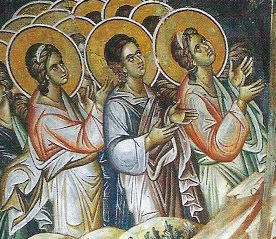
Returning to the Nativity Icon with its different elements - here is the angel-choir of Christmas night filling the sky after the shepherds had been directed to Bethlehem.

And suddenly there was with the angel the multitude of the heavenly host, praising God and saying: "Glory to God! Glory to God in the highest! And peace on the earth!"

Father Rahner says that angels are the entourage of Christ. They are present at the announcement of his conception, at the end of his forty day prayer in the desert, at his suffering in the Garden of Gethsemane the night before his death, at his Easter Rising. Eastern icons place a row of angels at his Baptism, holding towels with covered hands.

But these are serenading angels. Lovely! I imagine we get close to knowing what the song might have sounded like when we hear Handel's Messiah: the Christmas angel-story  sung so memorably there. It is said that German Christmas carols put the Infant Jesus to sleep, while French carols wake him up. We should be sure to sing carols this week, even alone - to put Jesus to sleep, to wake him up - doesn't matter - only that they be sung with love.