Pauca Verba is Latin for A Few Words.
Showing posts with label Icon. Show all posts

Tuesday, July 5, 2022

Jesus Will Ask Me


When I die and stand before Jesus Christ who is my God, he isn't going to ask me about anyone else. He won't ask me about the two men who live in the neighborhood who got married. He won't ask me about the unmarried young woman with the baby, or the girl I heard had an abortion. He won't ask me about the atheist I met at a summer gathering. He won't ask me about the Jews or the people of color. He won't ask me about the woman who feels more comfortable as a man. He won't ask me about the parish woman I know who left the Catholic Church and now goes to the Episcopal Church on Sunday. He won't ask me about the Catholic couple who got divorced and remarried outside the Church without annulments. He won't ask me about the Republicans or the Democrats. He won't ask me about the co-worker's son who wound up in jail. He will only ask me how I loved these people. That requirement is written in the book he holds in Father Zenon's icon. 


N.B. The gist of this paragraph came to me from a friend who received it from a Quaker friend unknown to me. Adjusting it a bit, I've added the Christ-dimension, changed the pronouns from "you" to "me. Expanded the examples and added Father Zenon's icon of Christ the Teacher. 

Sunday, October 17, 2021

John the Baptist with Wings and Luke 7: 1-23


This 16th century detailed icon of St. John the Baptist with Scenes from His Life is found in the Yaroslavl Museum of Art, Russia. He is called, Forerunner, Precursor, Angel of the Desert. All around the border there are scenes from John's life. Some are biblical, others are apocryphal, like the image on the left where an angel leads the saint as a little child into the desert. 

But notice this, the central figure of John the Baptist wears wings. He is not an angel. Why wings then? In other icons, the wings are even larger than these, signifying the message of John: The Christ I announce has cosmic significance. They are often colored wings —dark red, green, bright orange with white borders. We can detect similar colors in the planets and stars, even without a telescope. 

This is simply my conjecturing: but wings are for spreading and for flying — that in Christ — announced by John, God has flung himself in fullness out of the heavenlies into our realm. Then further, that perhaps these wings suggest we might take our own flight from the un-spiritual world of our own mal-creation: the plastic pile-up, the oil soak, the money grab, the gun lust and weapon idolization, the toxification of water, the animal and tree extinction, the child inconvenience, the shopping addiction.

Finally, see the plants growing around the feet of John. They symbolize the full-blossoming of life when Christ comes into the world — beginning with our own personal worlds. The worlds of heart and mind. This is the message Jesus sends back to John.

18 The disciples of John told him of all these things. 19 And John, calling to him two of his disciples, sent them to the Lord, saying, "Are you he who is to come, or shall we look for another?" 20 And when the men had come to Jesus, they said, "John the Baptist  has sent us to you, saying, 'Are you he who is to come, or shall we look for another?'" 21 In that hour Jesus cured many of diseases and plagues and evil spirits, and on many that were blind he bestowed sight. 22 And he answered them, "Go and tell John what you have seen and heard: the blind receive their sight, the lame walk, lepers are cleansed, and the deaf hear, the dead are raised up, the poor have good news preached to them. 23 And blessed is he who takes no offense at me." 

Ah, there it is — Jesus lays out for John a world that is full-blooming with God's wedding-like love for us. 


Tuesday, December 1, 2020

May I See Myself


This icon of the Mother of God is found in the Church of Nativity at Bethlehem. Here, we see some of the pilgrims who have lined up to venerate the icon. There is a glass over the icon to protect it from lipstick, smudged hands, incense smoke and candle soot. But the glass provides another possibility. Did you notice, the glass acts as a mirror. The fellow who is second in line, sees himself even before he sees the icon. There it is: when I approach the holy, I see myself, invited to ask the essential question before God — Who am I?

I can settle for a host of exterior identifiers, some silly: I am an American, a parishioner, a denomination, the wearer of brands and labels, my likes and dislikes, a Democrat/Republican/Independent, a consumer, the driver of this or that vehicle,  who abides at this address, my credit card limits, my stock portfolio, the roles I assume. Nah!

Here's a little meditation. I might imagine myself taking a place on the pilgrim line. And when I find myself at the head of the line, perhaps with candle in hand and a prayer to see myself clearly by its light,  I ask...


Who am I? 

I am imagined into existence,
conceived,
brought to birth,
passed through water a second time,
en-spirited,
gifted.

I am
God's child,
mirrored in divine eyes,
Christ's friend and sibling,
Mary's dear one,
treasured.

I am
without a mask,
known,
still standing and
leaned in, in a world of woes.

I am
an interior world,
forgiven and freed,
held up,
held close, 
watched, but by loving eyes.

I am
spent and frayed,
healed and healing,
understood, 
trusted,
invited,
created for light,
awaking.


Tuesday, October 20, 2020

Mother of God Kyriotissa ~ But What Does The Icon Mean?


We cheat ourselves when we simply do religious things, show up reliably, but fail to ask why or what does it mean? This marvelous 6th century icon of the Theotokos Kyriotissa (Mother of God Enthroned) has been kept safe for centuries in the Sinai Desert Monastery of St. Catherine. And here it is for us to see, to gaze upon, to enter, pray before and with. But what does it mean?

For all of its symmetrical and static appearance, there's a lot going on in this image. Did you notice, the figures are in an enclosure. See the decorated wall in the upper left and right corners. This suggests that we are standing before them ~ we are at the threshold, the borderline which is a place of beginning. We can choose simply to nod and admire them from the outside, or, we can step over into the inner world of the angels, the saints, the Holy Mother and the boy Christ. The walls also suggest we can enter our own inner world where we may come to know ourselves truly and not as we pretend to be. Or maybe these are not two distinct rooms, but are one in the same.

Notice at the very top and center, God's hand appears, as if it has broken through the roof. The hand appears inside the little bit of a circle, which, if we saw beyond the painting's edges, it would form a complete circle, symbolic of God's realm. What does it mean? It means that in Christ, now, the dividing lines and barriers are opened. God is here. The angels understand and look up, perhaps to see what's going to happen next. They look startled by it, don't they? They are illumined, wide-eyed and awake. I want to pay attention like this.

Then we see the Mother of God sitting on a throne. Her feet are up on a slightly raised platform. Her legs are pointed to her left, as are her eyes. What is she looking at? or Who is she looking for? Perhaps she is looking for humankind in our spiritual crisis — the crisis of our having failed the paradise we were given to care for — that failure born of our winner-takes-all, might-makes-right, take-what-you-can-get, self-worship. That spiritual crisis! We don't avoid spiritual crisis because we do devotions and go to Mass. More than an ecological crisis, we're living in a spiritual crisis. Oceans choked with disintegrating, micro-plastic — that's a spiritual crisis. People in leadership are not understanding this. In her distant gazing, maybe the Holy Mother is searching for us in this crisis.

Notice that while the Mother sits and looks to her left, the Child sits with legs to his right but he looks straight out at us—at you—at me. Or maybe the Holy Mother and Child are looking into the distance, the future of what's to become of us, the future implications for our folly. 

But what makes the six figures distinctly Christian is their wide open eyes. When our physical eyes are really open, they are taking in light. But I want to take in spiritual light. The angels seem to be transformed into white-light. St. Theodore on the left and St. George on the right are looking directly at us, inviting us to wake up, that we might become truly good, gentle, united to God. They stand, grown up, in the virtue of attention. Christianity often talks about living the virtuous life (practiced goodness), but I can't say I've ever heard  a preacher say paying attention is a virtue. I think we'd be more apt to hear "paying attention" dismissed as, "Oh, that's Buddhist," even though Jesus said, "Consider the lilies, consider the little birds of the air."

Lastly, Theodore and George were warrior saints. Some Christians think of discipleship as a battle with a long list of outside enemies. I received a thick fundraiser envelope in the mail recently from a men's religious order that sees itself as fighting in the front lines of a great culture war. All dressed up in their dramatic habits, rows and rows of clergy who think they have a corner on truth, ready to fight the others who don't share their worldview. That can make for a kind of corporate, "buy my product" religion. 

But I'd say the real battle, the battle many people never think to undertake, is the battle with our own superficiality, materialism. We need to undertake a national battle to save our own weaponized, embalmed hearts. There's the battlefield of preferring to be unconscious to our consumerism and its negative spiritual effects. An evening of TV commercials offers a picture of how idiotic and ridiculous we are — products inviting us to share in the singing, dancing, laughing of our first-world-way. It's said that if the whole world consumed resources the way we do, five planets would be needed to hold the waste and garbage. Seeing the two warrior saints, I'd say the place of battle is not outside, but in our own unexplored souls, our psyche, our inside life. The place where we never change our minds. I listen to interviews with people these pre-election days — how superficial, how selfish and self-involved, how unaware many people are —  how disappointing. 

William Blake wrote, "The person who never alters his/her opinion is like standing water which breeds reptiles of the mind." 

Maybe we can close our time with prayer — before this Kyriotissa Mother of God.


O Christ, our God,

save us by your interface,

your wisdom-revealing eyes,

your high forehead of Immanuel,

your blessing hand,

your teaching scroll.


O enthroned Lady,

by the secure holding of your Son,

your searching gaze,

the dignity you bear,

the expansion of your thoughts,

your silent contemplation ~

lead us to all-goodness.


O Holy Martyrs Theodore and George,

by your spiritual enclosure,

your cultivation of a true humanity,

your gentling union with God,

by your cleanness of heart,

your virtuous attention,

your eyes open to spiritual light ~

keep us standing in our warfare 

against indifference and violence.


Amen.


Sunday, September 13, 2020

Are you wondering what to do?


This icon of Jesus' face was painted by Father Gregory Krug (1908-1969). There's an excellent article about Father Krug's life that can be accessed at the bottom of the page here. 

There are only a handful of Father Krug's icons still in existence. Many were lost, given away to friends or visitors. Painted on and with poor materials, even cardboard, the icons that remain are deteriorating. Living through the awful deprivation of the Second World War, suffering famine, poverty, stomach cancer, depression and mental instability, having been committed to an asylum and left to starve by the Nazis who deemed him useless, Father Krug's icons convey a tremendous sensitivity to suffering persons.

But what a grace that Father Krug discovered icon painting as a way to healing. His icon faces convey a deep interior life, marked by tenderness and sadness without sentimentality. He painted the icons of a small chapel for Russian children who were orphaned during the Second World War. In one of those orphanage icons, Jesus is seen holding a rolled up scroll. This is significant as he wanted the children to meet Jesus who asked nothing from them, who only wanted to bless them. 

How easily we're side tracked as adults - believing that Jesus asks monumental things of us. "Love one another," (Jn13:34), "I call you friends," (Jn15:15), Jesus said. Christians often make Jesus into a tiresome lawyer. In my boyhood catechism, Jesus looked disappointed, as if my six-year-old sins weighed him down. In this icon, Father Krug has shown us only the face and shoulders of Christ. He wants us to be totally focused and undistracted. But notice while Jesus looks out at us full-face, his eyes are diverted to his left. He is looking for us in the margins — where where we lose joy, optimism, confidence and hope.

One news commentator said recently, speaking metaphorically about the present state of things in our nation, "We need aloe for our burns."  

Not sure of what we are to do, aware of the the sickness, the poison, the anxiety, the burns? Might I suggest something new? Mark this blog-page, and each morning (if even for ten minutes) sit in silence before this icon of Jesus Christ. You might even place yourself before the icon, a little off center, where Christ's gaze can fall on you. Perhaps bring to mind that inner place you might identify as off in the margins. Divorced and remarried people, gay people, people of color, the poor, often feel themselves to be off and ignored in the margins. What about you? Me? You might imagine that you are, in your own way, one with them. Feel the solidarity, if you can or care to. Lastly, don't run away if you start to feel uncomfortable. Many of us (maybe all of us) need to be healed inwardly if we are ever to become full human persons.

The healing of the country's current sickness, our national chaos, the deep malaise, hatred and division that have overtaken us of late, will not be healed by a candidate's promises and our vote, however important that is, but by our own personal restoration and renewal. Gregory Krug found his inner healing by painting icons. We might find our own healing in gazing at them.

Read more about Fr. Gregory Kroug. Click here.

Sunday, September 6, 2020

"Joy of All That Sorrow"


There's a lot going on in this busy icon titled, "Joy of All That Sorrow."  The Mother of God is depicted standing on a slightly raised platform around which crowds of people offer their prayers, written on scrolls and presented by angels. The prayers being sent up say, "Visit and help us in old age and sickness," "Help those who suffer from cold and nakedness," "Give nourishment to the hungry," "Be with us in our traveling." That's okay, of course, but I'd suggest these prayers are rather generic, while St. Paul writes:

Rejoice in the Lord always; again I will say, Rejoice. Let all men know your forbearance. The Lord is at hand. Have no anxiety about anything, but in everything by prayer and supplication with thanksgiving let your requests be made known to God. And the peace of God, which passes all understanding, will keep your hearts and your minds in Christ Jesus.  Philippians 4:4-7

We might keep this icon nearby, and in our gazing-prayer imagine ourselves offering scroll-prayers expressive of "everything" in our own situation and time — our own national, cultural, ecclesial and global need. Perhaps scrolls that read something like these:


"Strengthen and protect the health care workers.' 
"Convert the indifferent and the cavalier."
"Bring order out of our cultural chaos."
"Give clean hearts to the politicians."
"Fresh vision to the clergy."

"Joy to the mourners and the suffering."
"Turn the bitter heart."
"Heal the gun lust."
"The bullying, blaming, name-callers."
"Soften stony hearts."

"Fill the greed-spawning emptiness."
"Cure the national anxiety."
"Bless the helpers; the restorers of calm."
"May we get our racial house in order."
"Grow me up in a new Christ-mind."


Notice that the Mother of God stands in a fanciful garden — a supra-real, blooming garden of great beauty (even sun and moon participate). I don't want to be an admirer, but to accept the invitation to enter this enchanted garden of wonder, life and light, where I may suspend my everyday concerns of shopping, cleaning, business (busyness), endless talking, and to enter a childlike world of humble simplicity and joy. The priest-monk Gabriel Bunge has said:

"A believer is not a gloomy type waiting for the end of the world (Apocalypse) but a rejoicing one. He (she) is optimistic about life, the world, people. No matter what." 

The word "gloomy" doesn't appear until the late 16th century. Shakespeare used gloomy to describe the woods. Gloomy aptly describes not a few Christians: dark, depressing, displeased, dim, unhappy, without hope, not expecting any good in persons. These Christians unknowingly deny the Incarnation — that all the world is sacred — that God, rather than disdaining and condemning our world, ping-ing us off into a black hole of punishment and loss, has gone to a great deal of trouble to be with us in healing, encouragement and the invitation to love. Once I get this — really down-deep get this, everything is fresh and different.


Tuesday, March 10, 2020

The Syriac Wonder-Working Icon of the Mother of God


Sitting in a diner at breakfast time this morning, I was just given my laminated menu when an elderly woman in the next booth, having breakfast with a friend, whistled through her fingers, summoning the young waitress. You know the sound—the kind of shrill, single-note whistle we'd associate with a man demanding his off-in-the-weeds dog return. Then I heard her laugh to her friend, "Oh, that was rude."

A great vulgarity has been unleashed. I fear we are no longer evolving, but devolving. And I thought, "How will we ever invite a woman to lead us as president when we can't manage giving a hardworking, young waitress her dignity?" 

What to do? I considered calling out this woman on her ugly behaviour, as I made my way to the door—but these are dangerous times, people weaponized and unpredictable. So when I returned home, I remembered that I had this photograph of the Wonder-Working, Syrian Mother of God icon. I've left the photograph large, so you can see her soft smile. She'll help me to recover from this exposure to low-end behaviour. And now to ask her for what we need as a nation:


O Wonder-Working Lady,
Mother of God
Mother of wounded Syria,
  and our Mother too—
We need more 
stargazers, 
wave-watchers,
songbird admirers and
forest bathers.

We need more
stream listeners,
rose inhalers,
honey bee wonder-rs,
nature mystery sleuths and
cloud contemplators.

We need more
moon phase ponderers,
seed planters,
animal rescuers,
beauty imagine-rs,
Latin chanters and
icon gazers.

We need more 
soil diggers,
green sprout detectors,
roadside recyclers,
beauty creators and
silence imaginers.

O Lady,
heal us by your
wide-eyed,
knowing gaze,
your gentle-ing smile,
your wisdom-filled mind 
  radiating new thoughts.
Save us by
  the gift of your effulgent son,
  Jesus, 
  the all courteous,
  all compassionate,
  all gracious one.

Amen.


Sunday, August 18, 2019

Cries of the Heart Before the Icon of Christ the Teacher


Jesus, we have been friends for a very long time,
but is there real love in my heart?

A splendid silver riza covers your icon, O Christ our God.
Pray that I would be more than your admire-r.

Your Gospel Book is opened to me, O Jesus.
I ask for my heart to do the reading.

O faultless one,
keep me safe from my own worst inclinations.

O strong arm of Christ,
reel me in close to you.

Before your gentle face, O Christ-God,
I pray for those with
tear-streaming eyes.

You look to the margins, 
O Jesus, my Saviour.
I pray for those who wish they'd never been born.

By your soft smile, 
O Gentle Christ,
tend to the egoists,
the tormentors,
the soul-less.

Beauteous Christ,
preserve wonder,
imagination and awe
within me.

Your mind, O Jesus;
divinize my own.

Kind Jesus,
erase the memories,
may I begin again.

By your blessing hand, O Christ,
lead me into the new land
of your teaching.

Share your energy with me, O Saviour,
quickening mercy,
compassion and love.


Sunday, July 21, 2019

The Kovenskaya Mother of God ~ Feast Day, July 23


The story of the Kovenskaya Mother of God icon is rather convoluted and not particularly memorable. The original 14th century icon seems to have disappeared along the way, probably during war time. Today, a copy of the icon is housed and venerated at the New Valaam Monastery in Finland.

The icon is of the Hodgetria style: the Holy Mother pointing to the Divine Child with her right hand. What makes the relationship between Mother and Child unique however, is that the Infant Christ holds a pigeon-nestling on a string. 

The icon is called wonder-working, which usually means inexplicable cures have taken place after prayer in its presence. But what I find most attractive is that the Kovenskaya Mother of God seems to have as her specialty helping people in their obsessions.  

Obsession is an early 16th century French word which comes directly from the Latin obsessio which means attack, blockade, a blocking up, besiege. Perhaps what comes most readily to mind are our cultural obsessions with drugs, drinking, pornography, eating or shopping. I'd suggest there's more than that.

Notice that the little bird is held on a string. Obsessions keep us tied down. Obsessions lay claim to a mind. Obsessions are an onslaught of thought, they own and embattle our minds. They can cause waste, distraction and fatigue. The young Christ would know that the little bird ought to be free to fly. 

My sense is that people want to be loved in some practical way. That's the task put before humankind. Perhaps the Christians ought to be the best at pointing the way, afterall, Jesus said: "A new commandment I give you: Love one another. As I have loved you, so you must love one another." John 13:34-35. 

But one needs to possess a degree of inner freedom to know (experience in the heart) the love of Christ and to live well his way of love. Here, the Mother of God understands - she is looking at us, not her Son. We might bring that awareness to our prayer before the icon:


From the needy claims we place upon others,
From the worn out mental tape of ugly resentments,
From listening to people who would take us along a toxic way,
From sweet revenge,
From the allure of negativity,
  deliver me, O Lady.

From endless blaming,
From obsessing over money and things,
From fixating on work,
From a hypochondriac preoccupation with health,
From masks, defensiveness and wounded pride,
  deliver me, O Lady.

May my anguish be calmed,
May the arms of my heart be strengthened,
May saints find me among the clean of heart,
May my soul experience free flight,
May we be freed of our fascination with weapons and war,
  pray your grace, O Lady.


"The function of prayer is not to influence God, but rather to change the nature of the one who prays." Soren Kierkegaard

Friday, July 19, 2019

The 700,000th Pageview


This rather westernized 16th century icon (Virgin Mary and Child with Apple), depicts the Mother of God wearing a lovely robe and highly decorated maphorion. It is an image of great intimacy isn't it? Mary's mantle enfolds Christ as she pulls him in so close. 

Jesus is depicted as a little man. He is the Lord holding his scroll of teaching. It is for us to unroll it, read it, ponder it, translate it into new living. Mary looks directly at us. It is a knowing gaze.

But here is the most intriguing bit: the apple she holds and which he touches, is upside down. Of course we think of the fruit of the Garden of Eden, when Adam and Eve turned everything upside down by their wrong choosing. Things devolved after that eating, eventually brother killing brother, right up until today with creation and relationships deteriorating before our eyes.

Christ, born of Mary, can turn things right side up, but only if he is taken into a life personally and freely. That person can become a new creation, a new man, a new woman, a new kind of human person whose new life is born of love. But it is real love asked for - a mind changing love. Not sentiment.

Yesterday marked the 700,000th page view of Pauca Verba (a few words). This blog has been up since March of 2013. Along the way, folks have tuned in now over 700,000 times and from countries all around the world, not just the United States: Italy, Germany, Russia, Canada, Spain, Egypt, United Kingdom, Greece, Poland, Ukraine, France, Argentina, Philippines, Croatia, Singapore, Vietnam.

This blogger-priest is just a pointer. A grateful pointer! Thank you for coming along, for looking in, for contemplating these things with me, for joining the prayer. I send a blessing to your home.


Sunday, June 2, 2019

Her Indigo Mantle


In the 2018 restoration of the Salus Populi icon, Mary had her mantle restored to its original indigo. The King James Version of the bible uses the word indigo more than forty times. Other translations more simply say blue. But we know the biblical blue was not baby boy blue or even what a 1950's Catholic would recognize as Blessed Mother Blue. In the icon, the Mother of God, holding her Divine Child, has stepped up to heaven's window, wearing a globe-covering maphorion of indigo blue: we are covered with heaven.

But as indigo is a rich color, so is its meaning. It is the color of intuition or perception - what we might call the third eye - that capacity to know someone deeply by looking at them, even before  words are spoken. 

Indigo is the color of integrity, which is deep sincerity. It is the color of devotion, justice, wisdom, fairness and impartiality. The world could do with being wrapped in some of this. Indigo seems to reduce things to their most fundamental and essential.  


Prayer to the Mother of God, Who Wears a Banishing Blue

Virgin Mary,
Banishing Blue, 
Dislodge the soul clogging resentments,
Dispel the exhausting fears,
Disperse the shade of cynicism,
Allay the hunger to be consulted,
Drive off the rehearsals of punishing revenge,
Expel the provocateurs of hate.

Virgin Mary,
Banishing Blue,
Scatter the tendency to keep God small and leashed,
Rout the old damage which causes us to hurt others,
Oust the hidden desire to be privileged and preferred,
Quell the noisy pride; the ugly arrogance,
Dismiss the joy-stealing complaints,
Cast out the un-Christly bits within.

Virgin Mary,
Banishing Blue,
Exorcise from the nation's heart the demon-spirit of gun lust.

Tuesday, May 28, 2019

Whose Gaze Is Searching ~ The Salus Populi Icon


Here is a detail of the Salus Populi icon: just the faces of the Mother of God and the Christ. I think there are two take-aways here. The first: notice that the Mother of God is looking out at us with full face and wide-awake eyes. However, she does not look directly ahead, but to her right. It is as if she is looking off afar to the margins. Is is a searching gaze.

Did you ever scope out a seat in the last row of a classroom because you were ill-prepared or late and didn't want to be noticed? Maybe it's something like that. She sees human kind where we hide in shadow and ignorance. She sees us in the things we think and plan that would shame us if they were known: the deals, the machinations, the covert plans, the things that take place underground, off in safe places, in hidden rooms and cells.

As she presents her Healing-Son to the world, she observes and is fully aware of us where we are at our worst. Salus Populi: she is Mother of the People - the people who build great cathedrals and discover cures, but also the people who kill children and can't stop blowing  up things.

Secondly, the Infant Christ doesn't look at us, but at his Mother. It would be very easy to reduce this to sentiment, "Oh baby Jesus is looking at his Mother lovingly." There is more to it than that. In any icon of the Mother of God holding her Infant Son, Jesus never looks like the delicate child on a baby food jar. He is always depicted as a miniature man. He is always the Lord. So here, this "adult" Jesus looks at his Mother, yes, but who is also his first disciple. She is the first to say yes to him.

And you and I are in the long lineage of those who say yes to Jesus. In effect then, he is looking at us, the other disciples. She is the first of us, the ones who go to Jesus, not to clap and cheer, but to learn. That's what a disciple is: one who learns. 

And the learning doesn't mean lamenting that I haven't read the catechism or dropped out of religious instruction after Confirmation, but that there is something heaven wants me to learn personally about how to live my life authentically and fully, as Jesus lived his.

Sunday, May 26, 2019

In Her Basilica Home ~ The Salus Populi Icon


This photograph is of Pope Francis visiting the side chapel of the Basilica of Saint Mary Major, where the Salus Populi icon of the Mother of God resides. The Pope visits her prior to every trip outside of Rome and then again, upon returning. It is a lovely custom he adheres to. 

Catholics love to decorate. There are dangers. Here, the newly restored icon seems lost in an ocean of carpet swirls, candle sticks and flowers, marble and metal angels. Hmm. I think the Mother of God and her Divine Son would much prefer to be on eye level with us - interfacing - as with the shepherds of Bethlehem and the Magi from the East. 

Christianity is the religion that claims God has a human face, like our own. God meets us first through the meeting of eyes, even before words. And if I am a Christian disciple then this aspect of interface is to be extended. As God looks out at me in Christ, so I am to look out at others, as God's own dear children. It is a summoning to great attention as I see and make eye contact with...

the special needs person who greets me at the door of the "thingdom come" store,
the young fellow behind the deli counter,
the other patients in the doctor's waiting room,

the pharmacist who fills my script,
the stranger at Mass who would like to join me in the pew,
the visiting priest from Africa,

the woman loading groceries into her car next to mine,
the children at the southern border who I see on the news,
the motorists stopped alongside me at the intersection light,

the men who maintain the lawns in this neighborhood (have I ever even waved?)
the women who change adult diapers in the nursing home where I visit,
the others who sit in the Twelve Step circle,

the fellow on the floor of the aisle stocking shelves,
the boy who delivers the pizza,
the others who inhabit this planet in every kind of  variety.


Tuesday, May 21, 2019

Meaning Discovered in the Salus Populi Icon


Notice that the Mother of God holds the Infant close to her and under her folded hands. This modeling pre-dates the Hodgetria "style" where Mary points to Jesus. The cross inside Jesus' nimbus indicates his divinity. He is an animated figure - seeming almost to be already in motion along the roads of Galilee. Christ's tunic is a royal red. There are vertical stripes on his shoulders called a clavus, symbolizing imperial power - his teaching is from heaven.

Aware of all that vexes us, Jesus blesses us with his right hand, while in his left he carries the Book of the Gospels. But notice that the book is closed. Perhaps it is for us to open. Is he daring us? Surely our eyes will fall upon some line that will require a change, a transformation, a letting go, an inner death to some old way of thinking. Some Christians never take the challenge. There is too much at stake for. They remain fans of Jesus, but not his disciples.

The Holy Mother carries a mappula in her left hand - a ceremonial handkerchief carried by imperial women. Mary is Queen of Heaven, surely, but I prefer to think she'd share the handkerchief with us who are "mourning and weeping in this valley of tears." 

There are an awful lot of broken hearts shedding an awful lot of tears shed on this planet, no? You're attentive to the news, yes? Years ago I had a colleague at school who told me she never reads a newspaper and doesn't have a TV. I asked her how she knew about what was going on beyond her own immediate concerns. She said, "If the world is going to end, someone will tell me." I think that's cavalier, and I wondered how she could pray from any felt place.


Sunday, May 19, 2019

Mother of Our Restoration


Here is a short video showing the fascinating restoration effort made to save the 6th century Salus Populi Romani icon of the Mother of God, which was introduced here in last Tuesday's post. Open your screen fully.

However wonderful the icon's cleaning and repair, perhaps of even more urgent importance is our own need for restoration - a return to wholeness and health for individuals, families, the nation, the Church, the planet itself. 

Delighting in the restoration of your icon, O Lady,
we ask for our own return to health and wellness, in...

the epidemic of our drug addiction,
the pestilence of gun lust,
the anguish of parents for the safety of their children,
the groan of the world living in poverty,
the contagion of our militarization,
the debility of our planet destruction,

the disease of distrust,
the bedevilment of our consumerism,
the malady of non-transformative religion,
the blight of resentment,
the torment of those who are hoping to be welcomed,
the contagion of blaming,

the affliction of self-deception,
the ailment of despair,
the scourge of non-questioning,
the illness of our disinterest,
the infection of this ruinous partisanship,
the sickness of all this killing,

the epidemic of our hatred,
the malady of power-quest,
the malignancy of superiority,
the toxicity of power-lies,
the infirmity of our ignorance,
the disorder of our wasteful greed.

Mother of Restoration,
of soundness,
of well-being,
may we inhale your brightness,
your luminous delicacy,
your searching gaze,
your spirit filled mind.
Amen.


Tuesday, May 14, 2019

Salus Populi: The Icon's Restoration ~ And Ours


This icon is titled: Salus Populi Romani. Arriving in Rome in 590, it is kept in the Pauline Chapel of the Basilica of Saint Mary Major. This is the icon which Pope Francis visits before and after each trip outside of Rome.

The icon's Latin title translates, The Health of the Roman People. But Rome, like Jerusalem and New York, is an international city - everyone from everywhere is there. So maybe we could adjust the title to something more universal, "Salus Populi - Health of the People." 

At the Pope's request, the Vatican Museum undertook a complete restoration of the icon in 2018. The before and after photographs above show us how badly that work was needed. The golden halos were restored, the faces and hands brightened, insect and wood-worm holes were repaired, the delicate colors uncovered, the icon's reverse side was varnished to strengthen the wood panel.

The "Salus Populi" Mother of God icon is unusually large: five feet high and three and a quarter feet wide. It is also filled with spiritual meaning: Mary's gaze, her handkerchief, her indigo maphorion (mantle), the way she holds the holy infant, his blessing hand, and closed gospel book. Perhaps over the next days we can ponder these things together - like going on a mini retreat!

But first: In 593, Pope Gregory prayed before the icon for the city of Rome which was suffering from the Black Plague. In 1571, Pope Pius V prayed for Rome during the naval Battle of Lepanto. In 1837 the icon was venerated during one of Italy's many Cholera Epidemics.

These historical events of healing and strength, and the icon's recent restoration, might help us further to focus our prayer for today. This Mother of God and her Child have assumed a stately pose. She is not down for the count before plague, cholera, naval battle or the polarizations which afflict us in our nation, or the many threats to populations and the planet itself today. 

Might we take a moment to offer a prayer to the restored and regal Mary we encounter so clearly on the right. Ask her and her Son to help us to stay standing and not to crumble before the menace and threats: May we remain alert, confident and strong.


Tuesday, April 30, 2019

The Raised Right Hand of Maria Advocata


Here again is the icon  of the Mother of God titled, Maria Advocata - Mary, Our Advocate, found in the Roman Church of Saint Alessio. Her empty left hand intercedes for humankind in our struggle and sorrow. She is blessed from above.

But her right hand is empty, open and raised. Is she waving a hello to us? Does she have her hand in the air because she wants to ask a question? I'd suggest perhaps she shares the vision and voice of God's ancient prophets. A hand in the air can be saying, STOP.  

Now some Christians are familiar with everything Mary has said in her many appearances, but they can't recall what she said in the prayer she prayed while pregnant and visiting her elder relative, Elizabeth. The prayer is called, The Magnificat. There's some pretty tough stuff in that prayer. Why are so many people disinterested in her message? No flowers of the fairest and the rarest; it's not Mary meek and mild. Mary said of God:


He has used the power of his arm,
  he has routed the arrogant of heart.
He has pulled down princes from their thrones
  and raised high the lowly.
He has filled the starving with good things,
  sent the rich away empty.  Luke 1:51-53


This sounds like Mary, pregnant with the one who will announce God's Kingdom-Rule among us, is already upending the world's business as usual. In this icon, perhaps her raised hand might be saying:

STOP aborting to extinction the Down Syndrome children, whose presence is all love.
STOP the annual destruction of the three trillion trees God has planted.
STOP the militarization of the planet that ends in the blowing up of school buses.
STOP turning God's oceans into a plastic soup.
STOP this fascination with outer space while your neighbor-countries dissolve into poverty and internal chaos.
STOP sexualizing and sensualising your children.
STOP your gun lust which leaves scores of young people massacred.
STOP placing your anxieties in other groups of people.
STOP your consumptive affair with money, owning and having.
STOP this fascination with your own face and figure and learn again to look outward towards others.
STOP your addictions to food and narcotics and feed your inner life.

Sunday, April 28, 2019

At the Start of May ~ Maria Advocata!


While staying at a Camaldolese guest house in Rome, I discovered the nearby Church of Saint Alessio, where this splendid 12th-13th century icon of the Mother of God is enshrined. She is Maria Advocata ~ Mary, Our Advocate.

The visitor gets the feeling that the Holy Mother is in motion - on her way - and catching sight of us, she stops and rotates slightly, as if to leave the frame, to interface with each of us, whose hearts are heaped up with concerns.

To emphasize this connection, the artist has edged Mary's maphorion with gold. Her lock-on gaze is the first thing we notice. She looks to the margins, where we can hide in anger and fear. She misses no one. 

I have nicknamed her: Mary Without A Phone. She is other-referred, which means her energy, her direction is other people, without the techno or emotional walls we place between ourselves and others. In the bowling alley the other day, the young dad, busy text-ing, missed his ten year old son's first strike. 

Notice that while she is not carrying the Divine Infant, her hands are active. Her left hand (under the fancy broach someone gave her along the centuries) while interceding or advocating on our behalf, is an empty hand. That's all we have - our emptiness. There are great paintings which depict the saints and benefactors laden down with crosses, palm branches, candles, books, instruments of their suffering, miniature churches and monasteries they founded. But  really, for all our achievements, we come before God with surrendered, empty hands, anticipating the searching kindness of God's love, which fills and fulfills.

Next up: Some thoughts about Mary's raised right hand. Stay tuned.


Tuesday, February 5, 2019

We fly...!


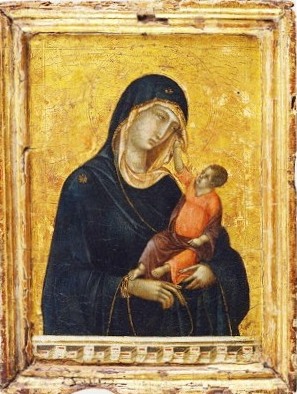
Here is another painting, Madonna and Child, painted by the 13th century artist, Duccio di Buoninsegna. And along with it, the oldest known prayer to the Virgin Mary, dating to the 3rd century. 


We fly to your patronage,
O Holy Mother of God,
despise not our petitions in our necessities,
but deliver us always from all dangers,
O glorious and blessed Virgin. 
Amen.

Can you feel the prayer's urgency, We fly! And the title Mother of God (Theotokos) which was formally bestowed on Mary at the Council of Ephesus in 431 A.D.

The third line gets right to it: our lives are full of necessity. We bring all our anxious concerns to the prayer, not only for ourselves, but for our families and dear ones, the nation, the church and the world. The prayer acknowledges that we live in a dangerous world. But may I suggest, the greatest dangers are those which threaten our inner lives: 

  • the danger of our souls suffocating under so many possessions,
  • the dangers of becoming toxic by prevailing hatreds, 
  • the danger of willful ignorance and indifference. 
  • the danger of not evolving or becoming who we were created to be.

Name it for yourself: what awareness of dangers do you bring to this prayer? The painting is as personal as the prayer is - notice the Holy Child looks at his mother; while she looks at us.

The prayer then ends with a burst of praise: O glorious and blessed Virgin!


Tuesday, January 29, 2019

The Duccio Madonna and Child


Duccio di Buoninsegna (+1319) painted this image: Madonna and Child around the year 1300. His new style of painting is important for the shifting away from a strictly Byzantine depiction to a softer, more natural approach which invites a tender interaction. We can sense there is a human body under the drapery of Duccio's figures. 

Discovering that this very small image of the Mother of God is housed in the Metropolitan Museum of Art on Fifth Avenue in New York City, I pilgrim-ed there this past week. The journey for me was essentially 147 miles, but with the convoluted paths of bus and subway, I'm figuring closer to 200 miles. Even inside the museum, one has to navigate the European Collection, containing dozens of small galleries.

A docent was leading her museum tour when I arrived. One fellow was asking technical questions about egg tempera and the painting's crumbly frame. I was pleased when they moved on, leaving me alone to wonder if my thoughts might be the first prayer the icon had received in centuries of museum life.

So, here's my prayer (below) and a good photograph (above) that captures the light and brilliant colors of Mary's maphorion and the Child's robes.


This rendezvous, O Lady —
  yours of seven centuries,
  mine —
  the miles of my life,
  and the last two hundred,
  by bus, subway and foot,
  to this moment of encounter
  in gallery 644.

Encased in glass,
  there's no camera flash,
  no kiss,
  no kneeling,
  no incense,
  no touch — 
  no weeping,
  except the weeping of my heart
  for joy at having found you,
  and for our world of self inflicted wound
  into which you lean,
  over heaven's parapet.

The holy boy,
  pulling back your veil
  of golden threads,
  reveals your maternal gaze...

 Give us new eyes for seeing.

Father Stephen P. Morris